
中国が開発、BYDのブレードバッテリー、非常に重く、再利用・リサイクルとは相性悪く!これは、要らない!最悪!地球負荷絶賛協力する中国、ノルウェー会社と搭乗者!
https://xtech.nikkei.com/atcl/nxt/column/18/02462/070500017/
これが、中国・比亜迪(BYD)が独自開発した電池「ブレードバッテリー」である。
いわゆる角形缶タイプのリチウムイオン電池だが、かなり長くて重い。量産されている電気自動車(EV)向け電池としては「異質の存在」(電池の専門家)といえる。
BYD・シールから取り出したブレードバッテリー
寸法は長さ945mm×幅90mm×厚さ14mmで、質量は2600gである。(写真:ATTACCATO)
BYDのEV「SEAL(シール)」から取り出した電池セルは、寸法が長さ945mm×幅90mm×厚さ14mmで、質量は2600gだった。
正極材にリン酸鉄リチウム(LiFePO4)を使うLFP系で、負極は黒鉛である。電池の研究開発を行うATTACCATOの協力を得てセルの性能を分析し、
質量エネルギー密度は約185Wh/kg、体積エネルギー密度は約400Wh/Lであることを確認した。
弱音が漏れるほど分解しづらい設計
驚きの天板剥がしにクレーン投入
BYDの電池パックには、底面側に冷媒を流すための流路板が設けられている。
車両後方側の側面にはDC-DCジャンクションを配置していた。
このあたりは後回しにして、分解は電池パックの天板を固定しているボルトを外すところから始めた。
ボルトを全て外し、天板の角を引っ張ってみる。
順調に剥がれたのは最初だけで、ペンチで引っ張ったりバールでこじ開けたりしてみたがびくともしなくなった。
どうやら、天板と電池の間に樹脂を充填して固定しているようだ。
図2 電池パックの天板を剥がす
電池と天板の間は樹脂で接着されていた。
さらに強い力で天板を引っ張ってみる。
使ったのは、作業所の天井クレーンだ。
天板とクレーンをつなげ、少しずつ引き上げていく。
すると、バリバリと音を立てながら天板は剥がれ始めた。
強力に接着されていたので、大人10人ほどで電池パックを押さえていないと天板と一緒に持ち上がってしまうほどだった。電池パックの質量は560.0kgある。
天板の一部は電池側に固着して剥がれず
天板は、鉄板とガラス繊維強化プラスチック(GFRP)の2層構造だった。
天板を剥がして姿を現した電池セルは、4つのブロックに分かれていた。
ブロック1つ当たり43セル、合計で172個のブレードバッテリーが整然と並んでいた。
これは、日本車の一般的なバッテリーユニットである。
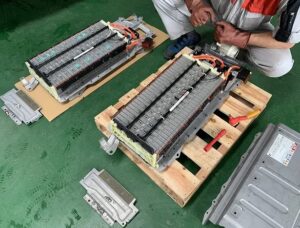
アホだと思うほど、BYDの環境負荷
地球環境を、悪くしたのは、中国とノルウィーと会社と搭乗者!と理解できた。
最悪だ。
リサイクルすらできない中国車を、運用したら最悪だ既に27万台も走らせている。
———————-
China developed, BYD’s blade battery, very heavy, poorly compatible with reuse and recycling! This is not needed! Worst!
This is the battery "Blade Battery" developed by China in China.
It is a so -called square can type lithium -ion battery, but is quite long and heavy. It can be said to be a "heterogeneous existence" (battery expert) as a mass -produced electric vehicle (EV) battery.
Blade battery taken out of BYD Seal
The dimensions are 945mm long x 90mm wide x 14mm thick, and the mass is 2600g. (Photo: Attaccato)
The battery cell taken out of the BYD EV "SEAL" was 945mm in length x 90mm wide x 14mm thick, and the mass was 2600g.
It is an LFP system that uses lithium phosphate (Lifepo4) as a positive poles, and the negative electrode is graphite. Analyzing the performance of cells with the cooperation of Attaccato, which conducts research and development of batteries
It was confirmed that the amount of energy density is about 185Wh/kg, and the volume energy density is about 400 WH/L.
Design that is difficult to disassemble enough to leak the weak sound
Introduce a crane to the surprising top plate peeling
The BYD battery pack has a flow board for flowing a refrigerant on the bottom side.
The DC-DC junction was placed on the side of the rear side of the vehicle.
This area was postponed, and the decomposition started by removing the bolt that fixes the top plate of the battery pack.
Remove all bolts and pull the corners of the top plate.
It was only the first thing that peeled off smoothly, and when I pulled it with pliers or opened it with a bar, I couldn’t get rid of it.
Apparently, the resin is filled and fixed between the top plate and the battery.
Fig. 2 Remove the top plate of the battery pack
The battery between the batteries was glued with resin.
Pull the top plate with even stronger force.
I used the ceiling crane in the workshop.
Connect the top plate and the crane and pull it up little by little.
Then, the top plate began to come off while making a crunchy sound.
It was strongly glued, so if about 10 adults did not hold down the battery pack, it would lifose with the top plate. The mass of the battery pack is 560.0kg.
Part of the top plate sticks to the battery side and does not come off
The top plate had a two -layer structure of iron plate and glass fiber reinforced plastic (GFRP).
The battery cell, which appeared by peeling off the top plate, was divided into four blocks.
A total of 172 blade batteries were arranged in orderly, 43 cells per block.
This is a general battery unit of Japanese cars.
The environmental load of BYD so that I think it’s stupid
I understood that the worse of the global environment was China, Norwee, the company and the passenger!
it’s awful.
The worst, 270,000 units have already been running a Chinese car that can not even recycle
———————-
———————-
中國開發了Byd的刀片電池,非常重,與重複使用和回收相兼容!這是不需要的!最糟糕的!
這是中國在中國開發的電池“刀片電池”。
這是一個如此被稱為的正方形可以鍵入鋰離子電池,但很長而重。 可以說這是一種“異質存在”(電池專家),作為大規模生產的電動汽車(EV)電池。
刀片電池從Byd密封中取出
尺寸為945mm x 90mm寬x 14mm厚,質量為2600克。 (照片:attaccato)
從BYD EV“密封”中取出的電池電池的長度為945mm x 90mm寬x 14mm厚,質量為2600克。
它是使用磷酸鋰(LifePo4)作為正極的LFP系統,負電極為石墨。 通過AttAccato的合作分析細胞的性能,該曲目進行了電池的研究和開發
已經證實,能量密度約為185Wh/kg,體積能量密度約為400 WH/L。
很難拆卸足以洩漏弱聲音的設計
將起重機引入令人驚訝的頂板剝離
BYD電池組有一個流動板,用於在底部流動製冷劑。
將DC-DC連接放在車輛後側的側面。
該區域被推遲,分解開始,啟動了固定電池組頂板的螺栓。
卸下所有螺栓,然後拉出頂板的角落。
這只是第一件事剝落,而當我用鉗子將其拉動或用酒吧打開它時,我無法擺脫它。
顯然,樹脂被填充並固定在頂板和電池之間。
圖2卸下電池組的頂板
電池之間的電池與樹脂粘合。
用更強大的力拉出頂板。
我在車間中使用了天花板。
連接頂板和起重機,然後一點一點地拉動。
然後,頂板開始發出鬆脆的聲音時開始脫落。
它是強烈的膠合,因此,如果大約10個成年人沒有固定電池組,它將用頂板生命。 電池組的質量為560.0kg。
頂部板的一部分棍子到電池側,不會脫落
頂板具有鐵板和玻璃纖維增強塑料(GFRP)的兩層層結構。
電池電池通過剝離頂板而出現,分為四個街區。
總共有172台刀片電池,每塊43個電池。
這是日本汽車的一般電池單元。
比特的環境負擔,所以我認為這很愚蠢
我知道,全球環境中最糟糕的是中國,諾維,公司和乘客!
太糟糕了。
最糟糕的270,000輛已經運行了一輛甚至無法回收的中國汽車
———————-
———————-
html>